Saturday, October 15, 2022

Arbuthnot Trial memories

Many thanks to Jon Hodges for sending in these pictures of vintage / classic trialing from days of yore. Jon saw the write up of this year's Arbuthnot and kindly took the time to share several images and memories.

This picture is from the first of the revived Arbuthnot
Trials in 1982. Jon is riding his '27 Scott Super Squirrel
which is still in regular use. That year the Arbuthnot
Trophy for the Colonial Class (standard road bikes)
just eluded Jon but he was victorious the following year.


In subsequent years the sidecar class was
added to the Arbuthnot and Jon put together
this Matchless / Watsonian outfit for the event.
This is the outfit but the photo was taken at
Fingle Bridge on a MCC event.


And when a pillion class was introduced Jon had
a crack at that too, also with the '27 Super Squirrel.
This image is from the Ralph Venables report in
Motorcycle News.

Thanks again for the photos Jon. They epitomise the enjoyment to be had with vintage and classic bikes.

Monday, October 10, 2022

Alpine touring with a BSA Golden Flash

There's not been a photo from back in the day on the blog for a little while so here's a couple of shots of a well loaded alpine touring BSA A10 Golden Flash.

The alpine view pic is marked to the reverse '1954 Austria'.

Even though the photo is in black and white it is clear to see that this BSA is not Golden in colour. The Golden coloured edition gave the model its name but even if the bike was finished in traditional black it was still known as a Golden Flash.


Monday, October 3, 2022

Arbuthnot Trial 2022

The Arbuthnot has been on my events 'bucket list' for a good long while. I can remember spectating it as a young whippersnapper with my father when there was a section next to 'Zig Zag Hill' just up the road from home.

The Arbuthnot has always been a proper old school trial with emphasis on traditional non-tricked out and modernised trials bikes with a good turn out of rigid framed machines. There is a 'colonial' class for road biased bikes. I seem to remember that way back when the trial was only open to rigid framed bikes. Times have moved on however and now all pre-65 British machines are welcomed.

First run after WW1 as a reliability trial the original Arbuthnot carried on through to the late twenties. The event is named after local 1900s TT hero Admiral Sir Robert Arbuthnot and was revived by the Salisbury Motorcycle and Light Car Club in the eighties and runs a route of some 70 to 80 miles along the green lanes, droves and farmland south of Salisbury.

My entry came courtesy of my friend Matt who kindly volunteered to hitch his sidecar on to his Ariel HT5 which he had entered as a solo when he found out that I was free for the day.

We had a fantastic day of riding. The event truly lived up to expectations. It's fair to say that it was tough going with the sidecar. The Dorset green lanes tend to be heavily rutted  and easy going on a solo but when your third wheel is on a track that doesn't correspond to any of the ruts things can get uncomfortable. 

We did manage though to clear a few of the sections and only had one spectacular 'off' where we rolled it into a clump of bracken. A soft landing at least.

There were four outfits entered. Purely by dint of being the only finishers we went home with the class winners award. Only just mind as our progress was so lethargic that we barely made the last three sections in time, the marshals had just started to take down the flags not expecting anyone else to come through so late...

A thoroughly recommended event with a great sense of camaraderie and one that I will certainly return to. Might just go for a solo entry next time though.

Following a few photos and clips from the day. No captions, it's all pretty self explanatory.


Tuesday, September 20, 2022

The Clément V4 and Gabriel Holley

Gabriel Holley

A little while ago I published an article on the remarkable Clément V4 motorcycle. Within the comments section I received a factual correction (which is always welcome here) to identify the rider of a Clément in a particular picture not as Maurice Fournier as I had thought but as Gabriel Holley, another prominent motor sportsman of the era. What was special about the correction was that it came from the great great grandson of Holley.

The rider carrying the number 51 is Gabriel Holley
and the chap to the left with the full beard is Adolphe
Clément.

Holley was a true pioneer of motor transport and was resident in Paris, a city I believe is fair to call the cradle of motoring. The path that characters such as Holley followed is one that is hard for us in the modern world to comprehend. Imagine a time when until just a handful of years prior the fastest personal transport known was a horse and the effects of high speed on the human body was unknown. These chaps raced point to point cross country at high speed on dirt roads through villages that until then had not even seen motorised transport. To race a 1.5 litre beast of a motorcycle with no suspension and little in the way of braking on rough roads at speeds up to 60mph would have demanded considerable mettle.

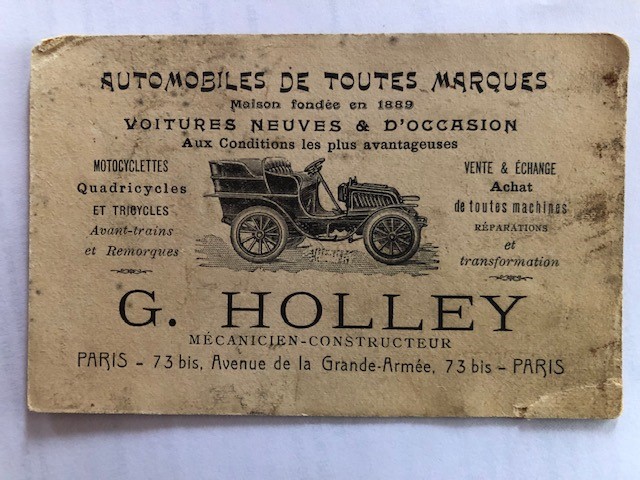
Poster for Gabriel Holley's garage business. Probably
the driver of the car is Holley.

As with many of the pioneer motorists Holley rode / drove both two, three and four wheelers as well as being a practical mechanic. Holley ran a repair and manufacturing shop in Paris that opened in 1889, he took on contract work for Clément, De Dion and Hurtu. Holley would have been 28 when the shop was opened. He was born in Poitier where his father, Thomas, owned a small hardware shop. No doubt the environment of a hardware shop would have contributed to Holley's passion for mechanics.

Holley's business card.

Holley was obviously well connected within the fledgling motor industry. In 1902 Holley had a gig riding the Clément factory machines. The Clément V4 is credited with being the first motorcycle to reach 100 km/h with Holley as the pilot. So far confirmation of this has not been found though certainly Holley and the Clément were at times in the high nineties in speed events. Interestingly during this period of racing the Clément's main rival was the Buchet parallel twin tricycle. Tricycles competed in the same class as motorcycles. Tuning techniques were in their infancy and the easiest way to more power was a bigger engine, thus a tricycle could carry a heavier weight (bigger engine) than a motorcycle and made for a very formidable racing machine. The Buchet was a 1885cc twin with a reputed 32hp on tap.

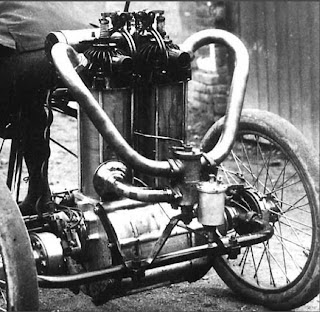
The Buchet tricycle.

The workings of the Buchet monster. The crank drove
direct to the axle so engine rpm translated directly to
wheel rpm.

From 1903 the Buchet twin was further developed
and fitted to a two wheeler chassis.

Apparently the Clément V4 was a very difficult machine to ride due to the weight of the very hefty engine in a long and spindly unsprung chassis. Adolphe Clément's son Albert had several falls trying to master the beast. Holley developed a new technique of braking hard before a corner and then accelerating through it, a technique that is now taught in race schools the world over as the fastest way around a bend.

In 1902 Holley competed in the Paris-Vienna race with a Holley-Clément tricycle powered by a De Dion Bouton engine. The following year he became a factory driver for De Dion and competed in the Paris-Bordeaux race in which he was the first De Dion Bouton voiturette finisher.

The attrition rate was high amongst the early motor sport pioneers but Holley went on to live to the age of 89 and died in 1951 in Levallois-Perret near Paris, where he was apparently still riding a bike up until the very end.

Many thanks to Jean-Christophe Gandubert for providing much of the information and several of the images used in this article.

Monday, September 5, 2022

Charlie Lucas Motorcycles

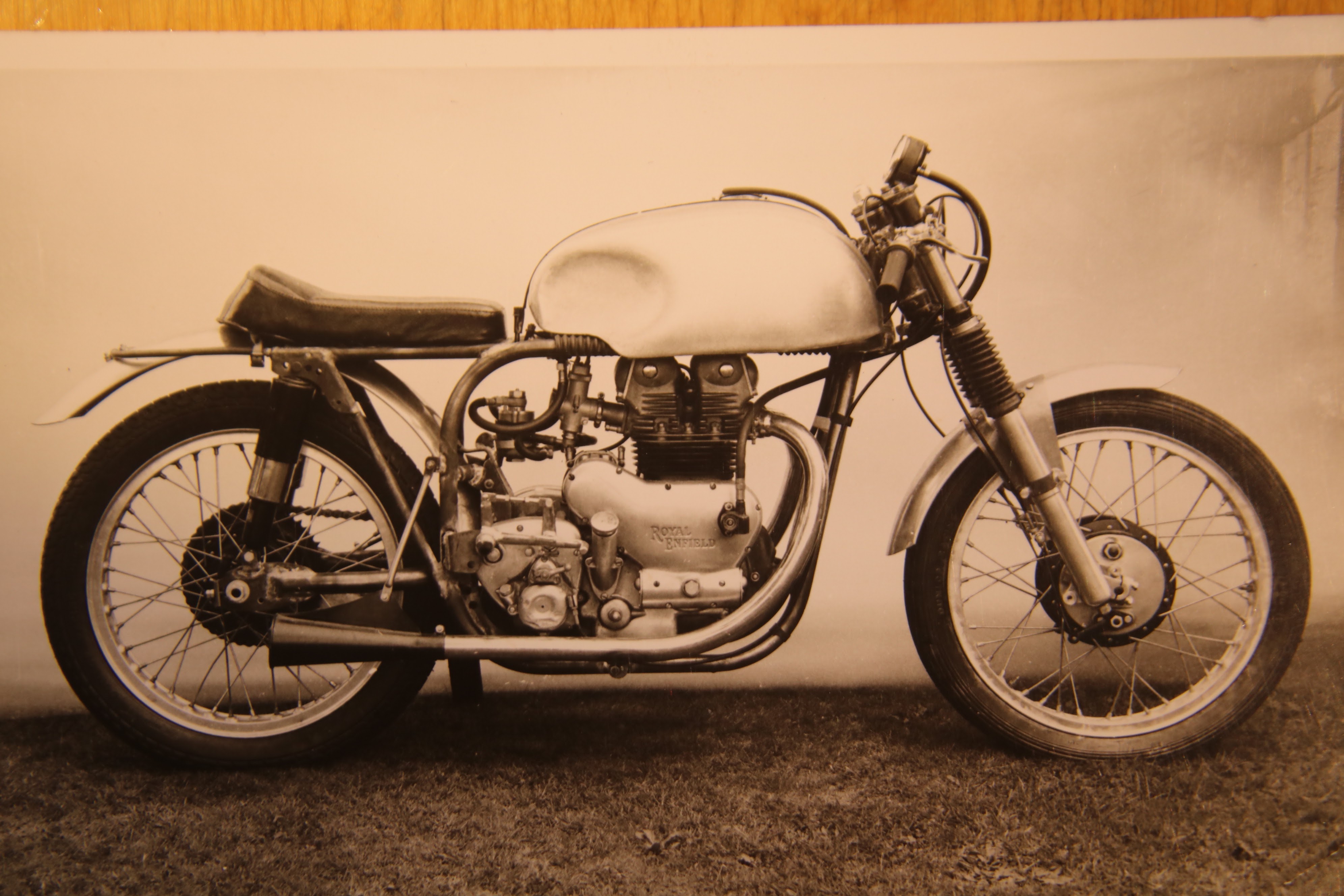
The inspiration for this article - my Charlie Lucas
Royal Enfield.

Not many enthusiasts will recognise the name of Charlie Lucas and be aware of the motorcycles he produced through the fifties. There is virtually nothing in print about his work and equally little on the internet, his bikes may be only a side note in post war British motorcycling history but are certainly worthy of remembering.

Charlie Lucas was an aircraft engine inspector from Watford and his passion was building motorcycles, more specifically individually designed motorcycle frames. How many frames were produced over the years is unknown but he appears to have been quite prodigious for a part-time builder.

From his home workshop immediately after World War Two Charlie Lucas began making grass track frames. At some point in the early fifties his interest switched to making road racing bikes.

The best known and perhaps most successful machine that Lucas was involved with was the MELEM special which was built in 1953 and was powered by a 250cc DOHC Manx Norton engine in a featherbed style frame fitted with Earles forks, Albion gearbox, Manx Norton front brake and EMC rear. The MELEM special achieved a thirteenth position in the 1954 Lightweight TT.

The MELEM Special

Lucas also made a series of Velocette engined race bikes (apparently all fitted with 'cut down' 250cc MkVIII engines).

Although not verified it is quite possible that Charlie Lucas built frames for the series of Velocette racers produced by Doug Beasley in the early fifties. These machines were raced by Beasely himself as well as Eric Pantlin, Percy Tait and Cecil Sandford.

One of the Beasely Velocettes. Possibly a Charlie
Lucas frame. The design is certainly very similar.

A feature of many of the Lucas bikes was Earles forks and variations of this design. Charlie also experimented with low profile framed bikes.

Apologies for the terrible quality of this image.
It is a 350cc Lucas Velo from 1952. There was also
a 250cc built at the same time which was possibly
fitted with a modified Rudge engine and had the
rear suspension units mounted beneath the engine
a la Moto Guzzi of the period.

Another Lucas Velocette, this one a 250cc. This machine
embodies several of Lucas' themes - note the leading
link forks fitted with an unusual tension spring unit
behind the wheel. Also note the low profile of the machine.

Sorry, another bad quality image! This is the above
bike in build stage, the image comes from a copy
of Motor Cycling magazine from 1955.

After the series of road racing machines Charlie Lucas turned his attentions back to grass track racing and resumed production of frames for that discipline. It is not known when exactly this was but some time around 1960 is a good estimate. An article at the time gave Lucas' reason for moving back to grass track as there being less work in a grass track machine, a greater and more readily available choice of engines for the discipline yet the sport was popular enough to provide a ready market for frames. Another reason given was that competition in road racing had become ever more serious. The early and mid fifties indeed was a heyday for the small scale amateur constructor in road racing, particularly in the 250 class, one that was largely forgotten by the bigger manufacturers.

Below are images of several of the surviving Lucas machines:

Again my Charlie Lucas Royal Enfield 500 twin.

And the Charlie Lucas Royal Enfield as first built.
Sadly no more is known of its history as of yet. The
engine cases are devoid of numbers and the gearbox
is an ultra rare close ratio racing one. Both of which
suggest if not actual Royal Enfield factory involvement
then perhaps someone who had close contact with or
worked at Royal Enfield.

This sweet little Lucas framed bike is in regular use
and currently sports a Ducati Monza Junior motor
which suits it nicely. Early history is unknown but
in its time it once had a BSA Sunbeam 250cc twin
scooter engine fitted.

Easy to mistake this as just another Triton but it is
in fact Charlie Lucas frame number 24. At one
time it had an NSU 250cc engine fitted. It sports
an NSU front wheel and an EMC rear.

Images used in this article are from myself, cribbed from the internet and from personal contacts. Most have appeared elsewhere but if I have unwittingly used an image without permission or consent please let me know and I will take down or acknowledge.

Tuesday, August 23, 2022

Labor's done

Time for a bicycle post....

Finishing a project is always a satisfying moment and bicycles offer easy wins over motors. This c1925 Labor took a while longer to complete than most as it was a bit of a wreck. Luckily the frame was sound but it had had a long a useful life as a 'porteur' followed by a period of poor storage when the wheels rotted into the ground.

The bike mostly came apart ok but the handlebar stem was well and truly stuck. Direct heat was out of the question as I wanted to preserve the original paint as much as possible. Given that the stem was quite likely not the original it was chopped off, this allowed the forks to drop out and then was the time to get truly medieval with the stump of the stem. With a lot of heat, a large drift and a lump hammer the stem gave up the unequal fight.

The frame and forks were treated with evaporust - rags were soaked in evaporust, bandaged on to the frame and then the whole lot was wrapped in clingfilm and left for a couple of days. Overall a pretty horrible job to do but it worked nicely. After washing the evaporust off and drying down the whole lot was then given a beeswax finish to preserve and stop any further corrosion.  

Once the frame and forks were sorted the other parts got the evaporust and wax treatment and it all went back together. Fresh wheels were found and are French from a similar period, the only snag being that the rims are 28 x 1 3/8". This size was used in France in the pre-war years and tyres are now very hard to obtain hence those that are fitted to the bike are a little past their prime. I found a supplier in Australia but the cost with postage and taxes was huge. Perhaps in the future the bike will receive a new pair of 28 x 1 1/2" rims which are fractionally smaller.

The only fly in the ointment of the project has been the lack of Labor head badge. So far I've not managed to find one so in the near future getting a replica made is on the cards if an original doesn't turn up.

The Labor was rebuilt with as many original parts
as possible, this includes the rear brake (no front
fitted) and coiled bare metal Bowden cable.

Frame detail on the Labor. Just enough paint left
to merit saving it.

Many French cycles of the period sported address
tags. This is the homemade one that was on the Labor.
Sadly I really can't make out what it says...

Another Labor frame detail. The truss frame design
was popularised by the success of Major Taylor
when he raced in France on his American made Iver
Johnson cycle with its patented truss frame. Labor took
out a license on the Iver Johnson design.

Handlebars and stem are not the original but they are
period correct and suitably patinated.

1920s French stem.

Typical french style frame mounted side pull brake.

A new chain was fitted. Thankfully the 1/2 x 3/8"
chain size is fairly universal for cycles of the period.

Those 28 x 1 3/8" tyres. 

Another detail of the truss.

Wednesday, August 3, 2022

Ariel Sloper

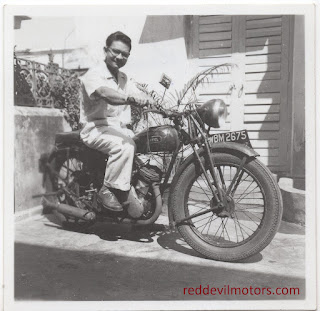
An unusual image and an unusual bike. From the surroundings and the bright sunlight this is fairly evidently not 1930s Britain, I believe the 'WBM' prefix number plate is from West Bengal.

And the bike? Obviously an Ariel, I believe an LB or MB either a 250 or 350 side-valve and most probably from 1931 or 32. Very rare bikes now, I've never seen one in the flesh. The first Ariel 'sloper' models had very radically canted forward engines before they move to a shallower angle as on this machine before up-righting the engines once more.

Ariel side-valve in 'British India'.