This brochure / manual is a copy of a copy but is rare enough that it warrants reproducing here.
The leaflet is labelled as 1898 and I believe that Ariel Tricycles and Quadricycles were current from 1898 to 1902.


Vintage and classic motorcycle blog. Documentation of a life-long two wheel passion. Tales from the workshop, period photos, brochures, event reports, rides and anything else two-wheel related. Keeps me sane whilst working at sea.
This brochure / manual is a copy of a copy but is rare enough that it warrants reproducing here.
The leaflet is labelled as 1898 and I believe that Ariel Tricycles and Quadricycles were current from 1898 to 1902.

A very early moto photo this one. Identification was thankfully easy as a close look will reveal. A pity that a family's personal album got broken up but if there are no relatives or those that are aren't bothered then what is to be done?
I'm not sure who this chap is, he seems rather distinguished and certainly wealthy. The building looks quite academic in style, I am wondering if it is in Cambridge? There was a prominent naturalist by the name of Charles Swinhoe in Cambridge but he would have been 62 or 63 when these images were taken. Perhaps his son (or sons - looks like the same chap in each photo to me but the initials are different..)
Either way, nice photos and an unusual early photo that uses the motorcycle and rider in the composition of the image rather than as the subject.
 |
| A C Swinhoe with his 1901 Minerva. |
 |
| M C Swinhoe in 1901. |
Apparently there are more veteran Triumphs on the Sunbeam MCC's Pioneer Register of pre-1914 machines than there are of all other marques put together. That's got to go a long way to explaining just why there such a disproportionate number of photos of the era feature Triumph motorcycles.
This particular image of a veteran Triumph is however a very good one. Very sharply focussed and quite artfully composed. As ever if you want to see a larger resolution of it then right click and open in a new window and then enlarge to original size (1200dpi).
Neat features on this particular Triumph are an aftermarket clutch, a rather unusual mounting for the acetyline lighting generator on the top tube above the petrol tank. Also note the very long leather flap in front of the engine to keep the magneto dry and perhaps a little bit of mud away from the riders feet too.
 |
| Artfully shot veteran Triumph. |
 |
| Baruch Blaker with BAT motorcycle c 1902. |
I have no more details about this superb postcard other than the caption. You've got to assume that the postcard was produced as a promotional tool for BAT motorcycles. BAT were named after the company's founder, Samuel Batson, and from the start were prominent in competition. Following competition success the company in 1903 adopted the logo, 'Best After Test'. The BAT in this image has a De Dion Bouton engine which should date it as 1901 or 1902.
I can't find much out about Baruch Blaker but he seems to have been quite a character. From what I can find he was a resident of Worthing in West Sussex and was a sporting cyclist from the earliest days. He was an early convert to motor bicycles and was a competition rider in the very first motor sport events. There is a record of him having competed at the first Brighton Speed Trials in 1905. He apparently ran a photography studio in Worthing from 1899 to 1904 and then later ran a shop selling bee keeping apparatus as well as wax and honey.
A really fascinating image this one, a little bit of research reveals that the picture was taken in Fisherton Street in Salisbury and the bikes are in front of Handel House music shop.
It's obviously a competition event from the competitor number armbands that the riders are sporting and it's early too. Being front on it's hard to see details on the bikes but I don't see a machine there that I would date later than 1910. On the left is a forecar, the forecar format was dropping from favour by 1905 and the last machines were made around 1907. The highest competitor number I can see is on the forecar and is 33, so a fairly large event for the time.
The Motor Cycling Club's Exeter and Lands End Trials both passed through Salisbury, the London-Exeter being first held in 1910 on Boxing day and the London-Lands End began in 1908 over the Easter weekend. Given the size of the event and the clothing the riders are wearing suggesting that it is not the very middle of winter I'm going to speculate that this image is of competitors in one of the very earliest of London Lands End London trials.
Just as an aside on the bikes, note that several have mascots tied on to the handlebars. A reminder - as with almost all images on this blog - the scans are high res, so right click and open the link in a new window and you can see them in all their glory.
 |
| A very early image of the London Lands End London trial? |
Summer is not long away now! Here's a postcard that is postmarked 1914. Postcards like this were printed in their thousands, the bike illustrated is generic and the same card and message would be printed with different town names, a variant for every seaside town in the country.
 |
| Having a ripping time in Bournemouth! |
It's just that, another veteran Triumph. The survival rate of veteran Triumphs versus other machines of the period and the number of period photos of them that turn up seem to suggest that they were rather popular at the time.
This particular snap is a nice one with very dapper riders and what looks like a new machine (at a best guess 1911) which is nicely accessorised with a curly horn and headlight.

 |
| Gabriel Holley |
A little while ago I published an article on the remarkable Clément V4 motorcycle. Within the comments section I received a factual correction (which is always welcome here) to identify the rider of a Clément in a particular picture not as Maurice Fournier as I had thought but as Gabriel Holley, another prominent motor sportsman of the era. What was special about the correction was that it came from the great great grandson of Holley.
 |
| The rider carrying the number 51 is Gabriel Holley and the chap to the left with the full beard is Adolphe Clément. |
 |
| Poster for Gabriel Holley's garage business. Probably the driver of the car is Holley. |
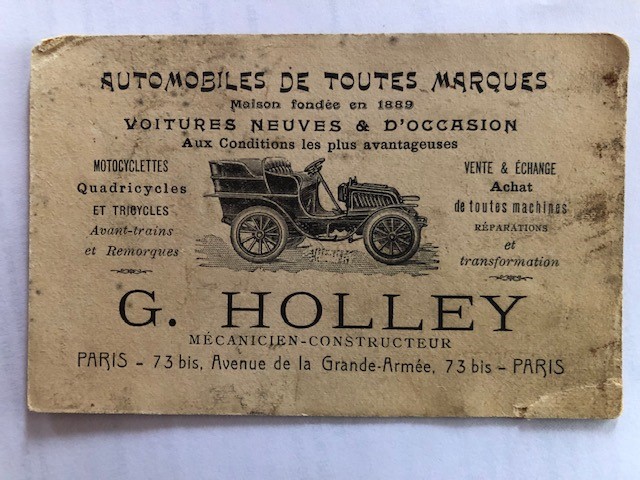 |
| Holley's business card. |
 |
| The Buchet tricycle. |
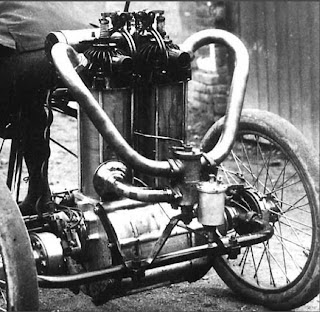 |
| The workings of the Buchet monster. The crank drove direct to the axle so engine rpm translated directly to wheel rpm. |
 |
| From 1903 the Buchet twin was further developed and fitted to a two wheeler chassis. |
Certainly the most sophisticated European machine of the veteran era, the FN was a grand touring machine par excellence - see Ron Fellowes' ' Old Bloke on a Bike' site detailing his epic travels from India to Belgium on a 1910 FN. Sadly Ron has just recently passed away.
The particular machine pictured below I believe dates from 1913. The image is rather good and scanned in high resolution so if you want to see all the detail right click and open the image in a separate tab and then enlarge away to your heart's content...
Note the top tube mounted klaxon. There is an annotation on the back of the image stating ' April 1919'.

'When tired of Cycling, try Spooning!'
As you may have guessed 'spooning' had a different and more innocent meaning back in the veteran era when it referred to flirtatious behaviour. All the same this probably would have been considered a risqué postcard back in the day. Apparently the phrase spooning has its roots in seventeenth century Wales where a young man would present an intricately carved wooden love spoon to the object of his affections. The spoon signalled his intent to both his amor and her family that he was a skilled man able to provide.
Of course of equal, or perhaps more, interest to us moto nerds is the bike. It's a very unusual v-twin Premier from roughly 1909. There's one in the Yesterday's archive of sold machines to compare:
https://www.yesterdays.nl/product/premier-1909-model-2-600cc-2-cyl-sv/
 |
| Premier gent spooning with two young ladies, what a cad! |
A rather amazing photo of a modified early veteran. A cafe racer of its day, it dates from around 1905. The engine is certainly a NSU (though I would have expected to see a magneto in front of the motor) and the frame parts generally match that id - there is a NSU in the National Motor Museum at Beaulieu that is very similar and is dated as 1906.
Most striking though is how far the bike has been modified, the front brake (contracting band) seems to have been removed, the petrol tank has been changed to a torpedo style one in plain brass, pedal gear has been swapped for footrests and the rear stand is abbreviated. The saddle has been lowered and positioned further back and the handlebars lengthened to match.
 |
| Veteran NSU, early custom bike! |
An early image here. The bike is a Werner, one of the true pioneer brands of motorcycles. Hard to pin a year on it exactly but I suspect the bike is a 1903 'New Werner'. The New Werner was introduced in 1901 and superceeded the previous model which had its engine above the front wheel - this caused various handling problems which may seem obvious to us today but for a technology in its infancy wasn't immediately so.
Something about the background of the image and indeed the rider cries out to me that this picture was taken somewhere in mainland Europe, perhaps Austria or Germany? Either way a great image of a very early motorcycle.
 |
| c1903 New Werner |
Not the finest quality photographs but cracking images none-the-less. I'm guessing the chap pictured goes by the name of Stanley going by what is written on the first image. I'm not sure of the exact year of the bike but 1912 is a good guess. The Speed model was, obviously enough, the sporting machine in the Bradbury range. Key differences from a standard non-sports model are the lack of pedalling gears, drop bars and shorter wheelbase. Many other manufacturers called their sporting mounts 'TT' models.
Stanley certainly looks like he means business, those bars are dropped even further down than a standard Speed model and the straight through exhaust is not standard either - the original terminated in a small cylindrical silencer in front of the engine. Note two interesting Bradbury features - the first and easiest to see is the cutaway in the petrol tank above the spark plug that allowed the tank to sit lower and gave an overall sleeker profile. The second and harder to see is that the crankcase forms a part of the frame - ie the case is cast around the saddle and main tubes. The crankcase is in steel and there is a large aluminium plate on the offside that houses the timing gears, etc.


A charming picture featuring a Motosacoche from the veteran era.
Motosacoche were a Swiss firm that started off in 1899 making bicycle attachments. The name literally means 'motor in a case' as the engine units were packaged within an enclosed triangular subframe that would bolt into a bicycle's main triangle.
The machine pictured here is a Model A that was made from 1901 up to 1910. Motosacoche went on to produce a large range of conventional motorcycles and MAG proprietory engines. Interestingly Motosacoche were paired up with Royal Enfield in the early days - they provided an IOE v-twin engine to Royal Enfield when they recommenced motorcycle production in 1910. Royal Enfield produced the cycle parts and sold it in the UK under the RE brand, Motosacoche produced a machine in turn that was near identical to the Royal Enfield and sold under their own brand name through Europe.
It's quite hard to come up with a back story to the photo. It is certainly very posed. The bell tent seems quite incongruous with the backdrop of what appears to be a windowless high sided wooden building with a corrugated iron roof.
 |
| Motosacoche - the motor in a case. |
Another veteran machine that I'm struggling to identify. It looks to be around 1912 or 1913, at first I thought Premier but it doesn't quite look right. Right click, open in new window and then enlarge to get the full sized image.
The motor is distinctive for having the magneto behind the engine rather than in front, forks are Druid type, other than that there are few easily identifying features. Do message or mail if you can put an id on the bike.
Some nice details in the picture though from the chap's serious riding gear to the three front headlights. There's some kind of long plunger / pump down at the front of the engine - no idea at all what that is for. On the handlebars are a mirror on the left side and a neat little cylindrical leather case on the right that seems a bit too small for a spare belt or tube.
 |
| Can you identify this veteran with wicker sidecar? |
Update 10/10/21 - Big thanks to Nick Smith for identifying the bike as a Humber 3.5hp of between 1909 and 1911.
A challenge for the veteran experts out there. I've personally completely failed to id this combo, best I can say is that it probably dates from 1912-1914. All images on this site are scanned to 600dpi so as a tip right click the image, open in a new tab and click on the image to enlarge. If you can put a positive id on the bike please do get in touch by mail or comment to share your knowledge.

 |
| Early thirties four and a half litre Invicta. |
 |
| Ultra rare engine and gearbox unit for a 1923 Rover 249cc Lightweight model. |
 |
| 1904 Maudslay racing car 'Big Maude'. The motor is ohc and 9.6 litres. |
 |
| Big Maude once more. |
 |
| Next to Big Maude was this beast. Alas I forgot to note details, sorry... Still worth seeing though. |
 |
| Another Invicta, this one was one of the few European visitors over from Germany. |
 |
| Also from Germany this lovely Delage. |
 |
| 1923 Evans Power Cycle. I think this machine was offered a couple of months back in the Vintage Motorcycle Club journal. Not sure if it was still at the same price or now had a bump on it. |
 |
| 1901 Clement. |
 |
| Veteran era 'Gregory' motor is a mystery. The stall holder knows nothing about the manufacturer and nor can I find anything. Looks to be around 1913 / 4 though. |
 |
| Clutch arrangement on the Gregory. |
 |
| This little Capriolo was very sweet and cheap at the offered price of £350. I was tempted but it needed a lot of work mechanically. This was one of those bikes that bumped around several stalls. The vendor offering it at £350 had bought it earlier that day and had a mark up on it. Later the same day I saw it on another stall! |
 |
| This sweet Beesa was offered at £6500 and I believe sold. A very fair price. Motorcycle sales were very slow this year and this Beesa was one of the few big machines that changed hands. Mopeds and ultra lightweights were however changing hands. |
 |
| Finally a lovely Humber forecar on the Veteran Car Club stand. |
It's still summer so it seems like a good time to publish this charming pic of folks enjoying their holiday. I would date the era as immediately pre-WW1. The bike is a lovely Humber with wicker sidecar and at best guess is from 1914.
 |
| Veteran Humber combination on holiday. |


