Showing posts with label racing. Show all posts

Thursday, July 6, 2023

Baruch Blaker and his BAT


Baruch Blaker with BAT motorcycle c 1902.

I have no more details about this superb postcard other than the caption. You've got to assume that the postcard was produced as a promotional tool for BAT motorcycles. BAT were named after the company's founder, Samuel Batson, and from the start were prominent in competition. Following competition success the company in 1903 adopted the logo, 'Best After Test'. The BAT in this image has a De Dion Bouton engine which should date it as 1901 or 1902.

I can't find much out about Baruch Blaker but he seems to have been quite a character. From what I can find he was a resident of Worthing in West Sussex and was a sporting cyclist from the earliest days. He was an early convert to motor bicycles and was a competition rider in the very first motor sport events. There is a record of him having competed at the first Brighton Speed Trials in 1905. He apparently ran a photography studio in Worthing from 1899 to 1904 and then later ran a shop selling bee keeping apparatus as well as wax and honey.

Thursday, November 10, 2022

Lundy Flyers Golden Mile

Waiting for an escort down the beach.
The jeep is a tender vehicle, all the tenders
were WW2 machinery. Very cool.

Been meaning to post this for a while as the event was back in early September but, hey, this isn't a hot of the press news site so it hardly matters.

I'm not a fan of the phrase 'bucket list' but taking part in a beach sprint has been on mine for a good while now. I knew from my work schedule that I would be at home for the Lundy Flyers event and it being in Devon it was relatively local.

As it turned out in the end I was kind of wrong on both these counts as come that weekend I could only manage to attend on the Saturday and it was a three hour drive from home, but totally worth it.

Saunton Sands 'village' in the distance, it's a long
beach and access is all the way in the distance.
Given the number of 'civilians' on the beach riding
to and fro needed an official escort.

The event is at Saunton Sands in North Devon and is organised by the Lundy Flyers, a local Hot Rod club. The entry is eclectic and the atmosphere wonderfully casual. Basically, enter, turn up and ride / drive. The racing is head to head and not timed so escapes too much regulation


I entered my ZB32 Gold Star, yes, I had some concerns about thrashing it on the sand but ultimately it's only a few runs and if you make sure to wash carefully immediately after there's no long term damage.

Over the day I got in about six runs down the 1/8th mile strip. The sand was reasonably solid but none the less as the speed gets up it's fairly hairy, just keep the power on and the weight back and cross your fingers. At least the ZB32 carries its weight nice and low. As above it's all fairly casual so it's definitely the taking part rather than the winning. On the day you chose a partner for the runs, just picking someone with a bike that looked like a fair match, it worked well, we (the Goldie and I) won as many runs as we lost and in the end most of it came down to gear changes and which line on the sand was taken.

So, in the end, yep, a brilliant day out and a fanstastic event. Totally recommended either as entrant or spectator. There's a really good friendly vibe there and some great machinery to watch being thrashed.


Tuesday, September 20, 2022

The Clément V4 and Gabriel Holley

Gabriel Holley

A little while ago I published an article on the remarkable Clément V4 motorcycle. Within the comments section I received a factual correction (which is always welcome here) to identify the rider of a Clément in a particular picture not as Maurice Fournier as I had thought but as Gabriel Holley, another prominent motor sportsman of the era. What was special about the correction was that it came from the great great grandson of Holley.

The rider carrying the number 51 is Gabriel Holley
and the chap to the left with the full beard is Adolphe
Clément.

Holley was a true pioneer of motor transport and was resident in Paris, a city I believe is fair to call the cradle of motoring. The path that characters such as Holley followed is one that is hard for us in the modern world to comprehend. Imagine a time when until just a handful of years prior the fastest personal transport known was a horse and the effects of high speed on the human body was unknown. These chaps raced point to point cross country at high speed on dirt roads through villages that until then had not even seen motorised transport. To race a 1.5 litre beast of a motorcycle with no suspension and little in the way of braking on rough roads at speeds up to 60mph would have demanded considerable mettle.

Poster for Gabriel Holley's garage business. Probably
the driver of the car is Holley.

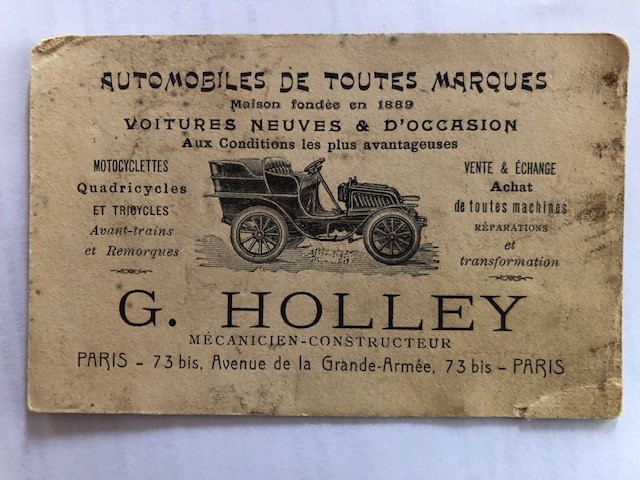
As with many of the pioneer motorists Holley rode / drove both two, three and four wheelers as well as being a practical mechanic. Holley ran a repair and manufacturing shop in Paris that opened in 1889, he took on contract work for Clément, De Dion and Hurtu. Holley would have been 28 when the shop was opened. He was born in Poitier where his father, Thomas, owned a small hardware shop. No doubt the environment of a hardware shop would have contributed to Holley's passion for mechanics.

Holley's business card.

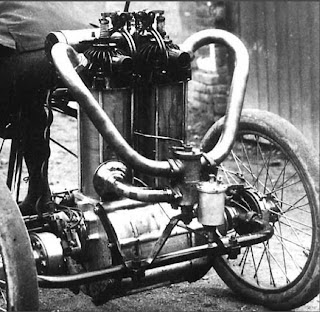
Holley was obviously well connected within the fledgling motor industry. In 1902 Holley had a gig riding the Clément factory machines. The Clément V4 is credited with being the first motorcycle to reach 100 km/h with Holley as the pilot. So far confirmation of this has not been found though certainly Holley and the Clément were at times in the high nineties in speed events. Interestingly during this period of racing the Clément's main rival was the Buchet parallel twin tricycle. Tricycles competed in the same class as motorcycles. Tuning techniques were in their infancy and the easiest way to more power was a bigger engine, thus a tricycle could carry a heavier weight (bigger engine) than a motorcycle and made for a very formidable racing machine. The Buchet was a 1885cc twin with a reputed 32hp on tap.

The Buchet tricycle.

The workings of the Buchet monster. The crank drove
direct to the axle so engine rpm translated directly to
wheel rpm.

From 1903 the Buchet twin was further developed
and fitted to a two wheeler chassis.

Apparently the Clément V4 was a very difficult machine to ride due to the weight of the very hefty engine in a long and spindly unsprung chassis. Adolphe Clément's son Albert had several falls trying to master the beast. Holley developed a new technique of braking hard before a corner and then accelerating through it, a technique that is now taught in race schools the world over as the fastest way around a bend.

In 1902 Holley competed in the Paris-Vienna race with a Holley-Clément tricycle powered by a De Dion Bouton engine. The following year he became a factory driver for De Dion and competed in the Paris-Bordeaux race in which he was the first De Dion Bouton voiturette finisher.

The attrition rate was high amongst the early motor sport pioneers but Holley went on to live to the age of 89 and died in 1951 in Levallois-Perret near Paris, where he was apparently still riding a bike up until the very end.

Many thanks to Jean-Christophe Gandubert for providing much of the information and several of the images used in this article.

Monday, September 5, 2022

Charlie Lucas Motorcycles

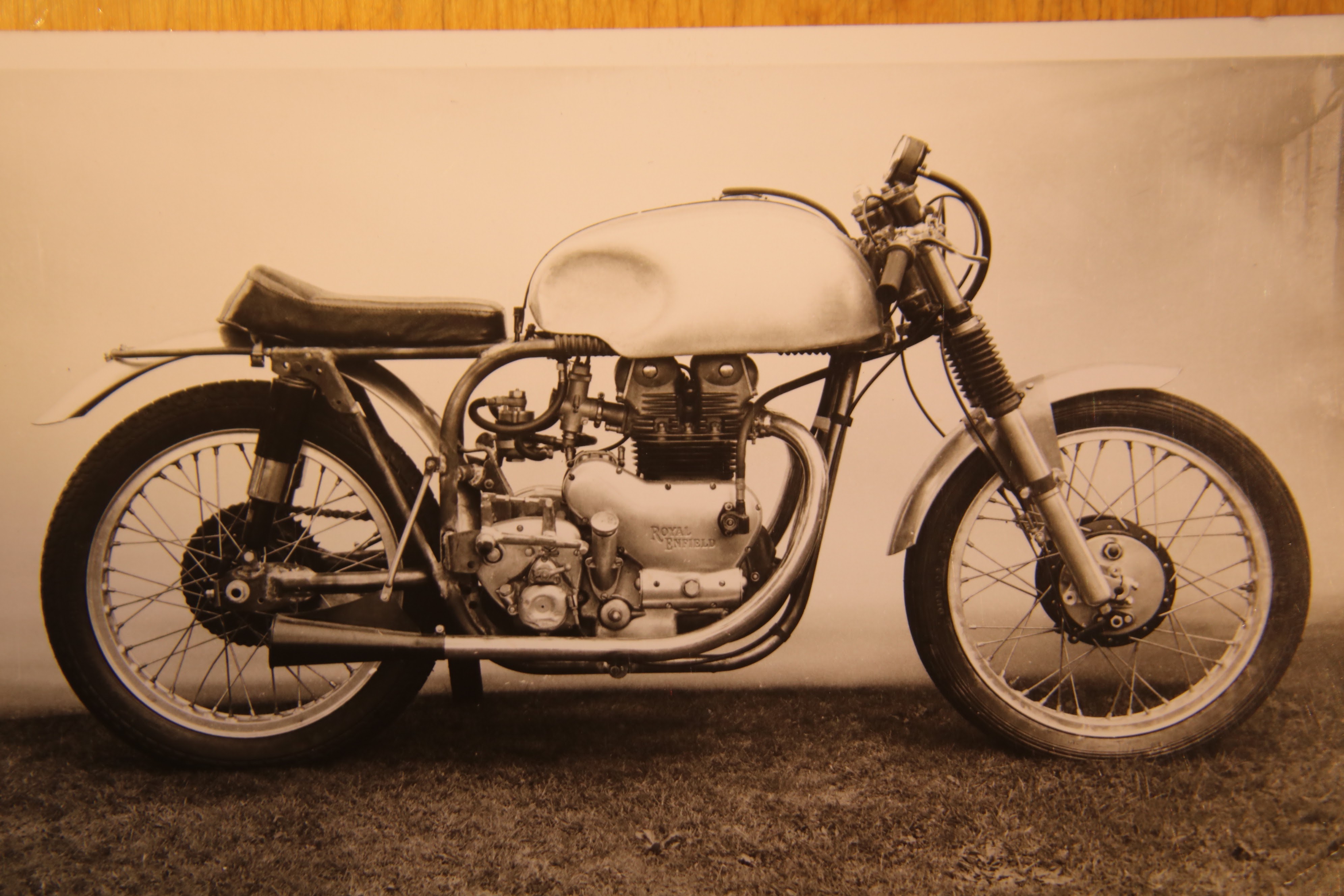
The inspiration for this article - my Charlie Lucas
Royal Enfield.

Not many enthusiasts will recognise the name of Charlie Lucas and be aware of the motorcycles he produced through the fifties. There is virtually nothing in print about his work and equally little on the internet, his bikes may be only a side note in post war British motorcycling history but are certainly worthy of remembering.

Charlie Lucas was an aircraft engine inspector from Watford and his passion was building motorcycles, more specifically individually designed motorcycle frames. How many frames were produced over the years is unknown but he appears to have been quite prodigious for a part-time builder.

From his home workshop immediately after World War Two Charlie Lucas began making grass track frames. At some point in the early fifties his interest switched to making road racing bikes.

The best known and perhaps most successful machine that Lucas was involved with was the MELEM special which was built in 1953 and was powered by a 250cc DOHC Manx Norton engine in a featherbed style frame fitted with Earles forks, Albion gearbox, Manx Norton front brake and EMC rear. The MELEM special achieved a thirteenth position in the 1954 Lightweight TT.

The MELEM Special

Lucas also made a series of Velocette engined race bikes (apparently all fitted with 'cut down' 250cc MkVIII engines).

Although not verified it is quite possible that Charlie Lucas built frames for the series of Velocette racers produced by Doug Beasley in the early fifties. These machines were raced by Beasely himself as well as Eric Pantlin, Percy Tait and Cecil Sandford.

One of the Beasely Velocettes. Possibly a Charlie
Lucas frame. The design is certainly very similar.

A feature of many of the Lucas bikes was Earles forks and variations of this design. Charlie also experimented with low profile framed bikes.

Apologies for the terrible quality of this image.
It is a 350cc Lucas Velo from 1952. There was also
a 250cc built at the same time which was possibly
fitted with a modified Rudge engine and had the
rear suspension units mounted beneath the engine
a la Moto Guzzi of the period.

Another Lucas Velocette, this one a 250cc. This machine
embodies several of Lucas' themes - note the leading
link forks fitted with an unusual tension spring unit
behind the wheel. Also note the low profile of the machine.

Sorry, another bad quality image! This is the above
bike in build stage, the image comes from a copy
of Motor Cycling magazine from 1955.

After the series of road racing machines Charlie Lucas turned his attentions back to grass track racing and resumed production of frames for that discipline. It is not known when exactly this was but some time around 1960 is a good estimate. An article at the time gave Lucas' reason for moving back to grass track as there being less work in a grass track machine, a greater and more readily available choice of engines for the discipline yet the sport was popular enough to provide a ready market for frames. Another reason given was that competition in road racing had become ever more serious. The early and mid fifties indeed was a heyday for the small scale amateur constructor in road racing, particularly in the 250 class, one that was largely forgotten by the bigger manufacturers.

Below are images of several of the surviving Lucas machines:

Again my Charlie Lucas Royal Enfield 500 twin.

And the Charlie Lucas Royal Enfield as first built.
Sadly no more is known of its history as of yet. The
engine cases are devoid of numbers and the gearbox
is an ultra rare close ratio racing one. Both of which
suggest if not actual Royal Enfield factory involvement
then perhaps someone who had close contact with or
worked at Royal Enfield.

This sweet little Lucas framed bike is in regular use
and currently sports a Ducati Monza Junior motor
which suits it nicely. Early history is unknown but
in its time it once had a BSA Sunbeam 250cc twin
scooter engine fitted.

Easy to mistake this as just another Triton but it is
in fact Charlie Lucas frame number 24. At one
time it had an NSU 250cc engine fitted. It sports
an NSU front wheel and an EMC rear.

Images used in this article are from myself, cribbed from the internet and from personal contacts. Most have appeared elsewhere but if I have unwittingly used an image without permission or consent please let me know and I will take down or acknowledge.

Tuesday, May 10, 2022

P & P v twin

Below the flyer for the 1925 ohv JAP v-twin Packman and Poppe racing 1000cc v twin. A formidable looking machine of which (as far as I am aware) there are no survivors.

Happily several P & P machines do however survive with different engines fitted, apparently there was just the one frame design which would take anything from a small sidevalve up to this beast of a JAP twin.

P & P have an interesting, if chequered history. The bikes have several distinctive features, notably an early use of a fully duplex cradle frame and the fact that the rear wheel bearings are hung in the frame rather than the wheel itself. The company was founded by Gilmour Packman and Erling Poppe and bikes were produced from 1922 up until 1930.

Packman was unfortunately killed in 1925 in an argument with a salesman when he stopped off at the company offices on the way to the TT. Later in the year the factory was destroyed in a fire. In 1926 the company was sold to John Wooler of Wooler motorcycles fame.

Erling Poppe later went on to design the Sunbeam S7 in line twin.

Flyer for the 1925 v twin racing model
P & P.

Wednesday, October 13, 2021

Charlie Lucas Royal Enfield hits the road

I've owned this machine for more years than I care to admit now. It was an unloved and unknown bike in a local auction and I won it as the sole bidder with a chancer bid. Purchase came with a first flush of enthusiasm, I started it up and took it to an event or two. Then I decided that if it was to be used in anger the motor should be checked out - the motor had been run on castor oil. As I was short on time and heavy on projects it went up to Paul Henshaw of Performance Classics in Wales. I collected it running, Paul had done a cracking job as expected in stripping, cleaning and servicing. Then a misfire crept in and it was evident that the mag needed rebuilding as well as the engine. In the meantime I managed to get the bike road registered.

The mag was duly rebuilt but I got the timing wrong. Trying to test run a bike with no kickstart when you live on top of a hill is not much fun so I got dispirited and wheeled it to the back of the garage for a period of contemplation.

1950s Charlie Lucas Royal Enfield 500 Twin.

From purchase onwards I had no idea who made the bike, I had a couple of leads but they got me nowhere. Then out of the blue I saw an original picture of the bike from back in the day in the letters section of Old Bike Mart magazine. A breakthrough moment for the bike and for my enthusiasm.

It was always evident that the bike was of decent build quality and a step up from something homemade and so it proved to be. The engine is a Royal Enfield 500 twin, not a particularly noteworthy sports engine but back in the early postwar club racing scene you made do with what you had. The frame is very similar to a Featherbed Norton but with a few subtle differences. The gearbox is a rare close ratio and the only real concession to tuning seems to be the twin carbs and megaphone pipes.

The ID of the bike is that it is a Charlie Lucas made machine. Charlie was a bike dealer in Watford who had a sideline in producing speedway frames and bespoke frames for road racing. It's unclear of how prodigious his output was but it is fair to say low. Charlie was famous for making the frame of the 'Melem Special' a successful one-off DOHC 250cc machine campaigned in the early and mid fifties.

1950s Charlie Lucas Royal Enfield 500 Twin.

The next breakthrough came in the purchase over the summer this year of a set of electric starter rollers from ebay. A total gamechanger in fettling something like this. I re-timed the bike and got it running sweet. Next step road tests. It's quite a buzz riding an original and unrestored fifties road racer out on public roads. Riding position is brutally uncomfortable for my six foot two frame, the footrests are ludicrously high and all my weight falls on to my wrists. The gearing is very high and to get a decent pace up the bike needs to be thrashed, brakes are standard Enfield and though fine for a Bullet or suchlike are slightly below par for this application. I took the bike along to a local VMCC run for fun but had to decline and head back home from the start such was the discomfort...

Next steps are light fettling and further investigating the bike's history with the leads I have. It's remarkable to have a period race bike in such unmolested and original condition, this perhaps means that it wasn't used much and will be hard to trace in race results / programmes? Some time in the bike's life 18 inch rims have been fitted, I have the original 19 inch ones and shall fit these back on soon. That should improve the grace of the bike and make it look slightly less chunky. Moving the footrests will be tricky but changing the handlebars is not, so a pair of swan-neck clip-ons will be substituted. Lowering the gearing with a smaller gearbox sprocket should make it slightly more manageable (I barely managed top gear on test runs). That should all be easily achievable by next season. After that it's just to get out and enjoy using it.

Saturday, February 20, 2021

Thirties sketches

This series of sketches was a lucky find in a small box of pre-war literature that I picked up recently. Sadly the condition is a little poor, looks like the proverbial book worm has had a good old nibble at some of the sheets.