This brochure / manual is a copy of a copy but is rare enough that it warrants reproducing here.
The leaflet is labelled as 1898 and I believe that Ariel Tricycles and Quadricycles were current from 1898 to 1902.


Vintage and classic motorcycle blog. Documentation of a life-long two wheel passion. Tales from the workshop, period photos, brochures, event reports, rides and anything else two-wheel related. Keeps me sane whilst working at sea.
This brochure / manual is a copy of a copy but is rare enough that it warrants reproducing here.
The leaflet is labelled as 1898 and I believe that Ariel Tricycles and Quadricycles were current from 1898 to 1902.

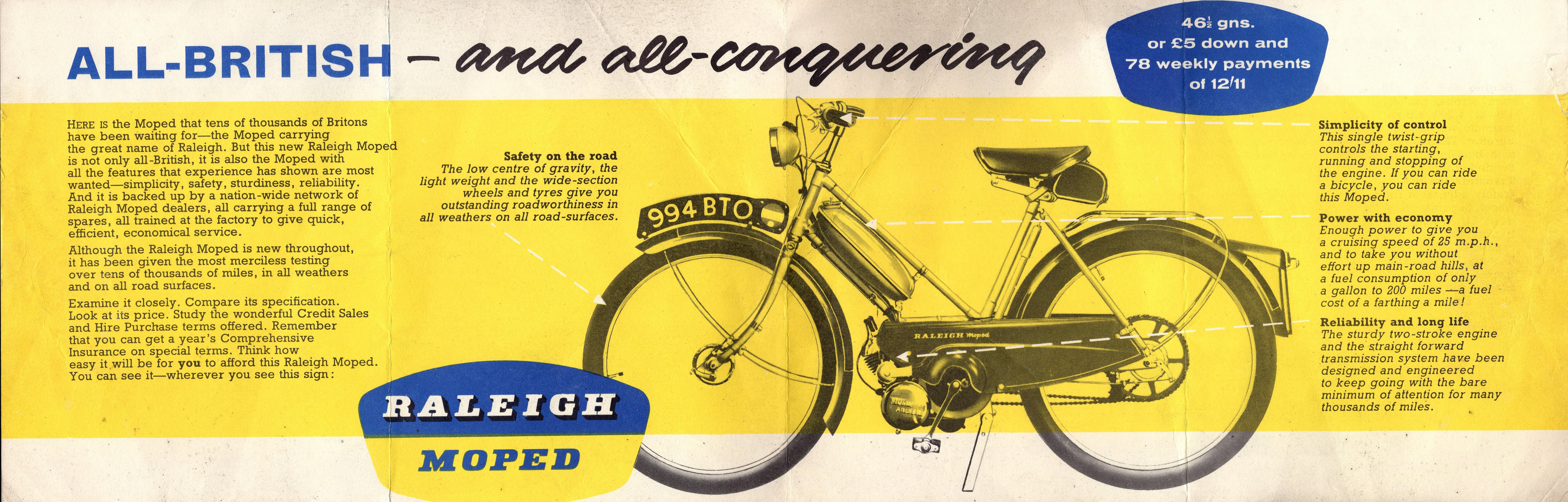

Ambassador was perhaps the most interesting of the crop of lightweight motorcycle brands that sprung up post WWII. This was largely in part due to the proprietor, Kaye but also because the products were a cut above the average in quality and design.
Irish born and of Polish heritage (his name was Donsky before shortened and anglicised to Don), Kaye Don was the archetypal gentleman racer of the inter-war period. He had served in the Royal Flying Corp in WW1 and post war he raced motorcycles, cars and speedboats and was even involved in land speed record attempts.
To find out more about Kaye Don see:
The Vintagent article on Kaye Don
The Ambassador moped was a brave attempt at a quality British moped to take on the likes of the NSU Quickly and other continental success stories. It was something of a swansong for Don as he retired the year after the Moped was introduced and (perhaps quite astutely) sold the business to DMW just before the real decline in the British Motor Cycle industry fully kicked in.
There is a great write up on the Ambassador Moped on Andrew Pattle's Moped Archive: http://www.users.globalnet.co.uk/~pattle/nacc/arc0372.htm
________________________
25/01/2023:
I've received this information from Ambassador guru Michael Easton:
There is quite a story behind Ambassador's Moped, but suffice to say that the Ambassador Machine Register currently (Jan 2023) records just seven surviving Ambassador Mopeds. Essentially just re-badged and repainted Solifer Type 47 mopeds from Finland, but with the perfectly good Solifer engine removed and fitted with the not-so-good Villiers 3K engine.
Thank you Michael.
________________________


Avon's brochure from 1963 for their 'cling' rubber tyres. Even today 'cling' still appears in some of the Avon promo material.
For fun there's also a couple of youtube clips below:
The first is a promo for motorcycle cling tyres, unfortunately it looks like it has been filmed on a phone looking at a cathrode ray tv through a fish tank but is still worth a quick watch.
The second is celebrating 100 years of Avon Tyres published by Ride Magazine, not much informative content but it features a guy wearing a suit hooning around on a Vincent Rapide.


A two page flyer for DOT competition bikes from c1950. These bikes used the Villiers 197cc 6E motor, a competent power plant that's still popular in pre-65 trials today. DOTs were always nicely styled quality machines and they had a strong competition heritage. Note the odd megaphone end of the exhaust on the trials model.


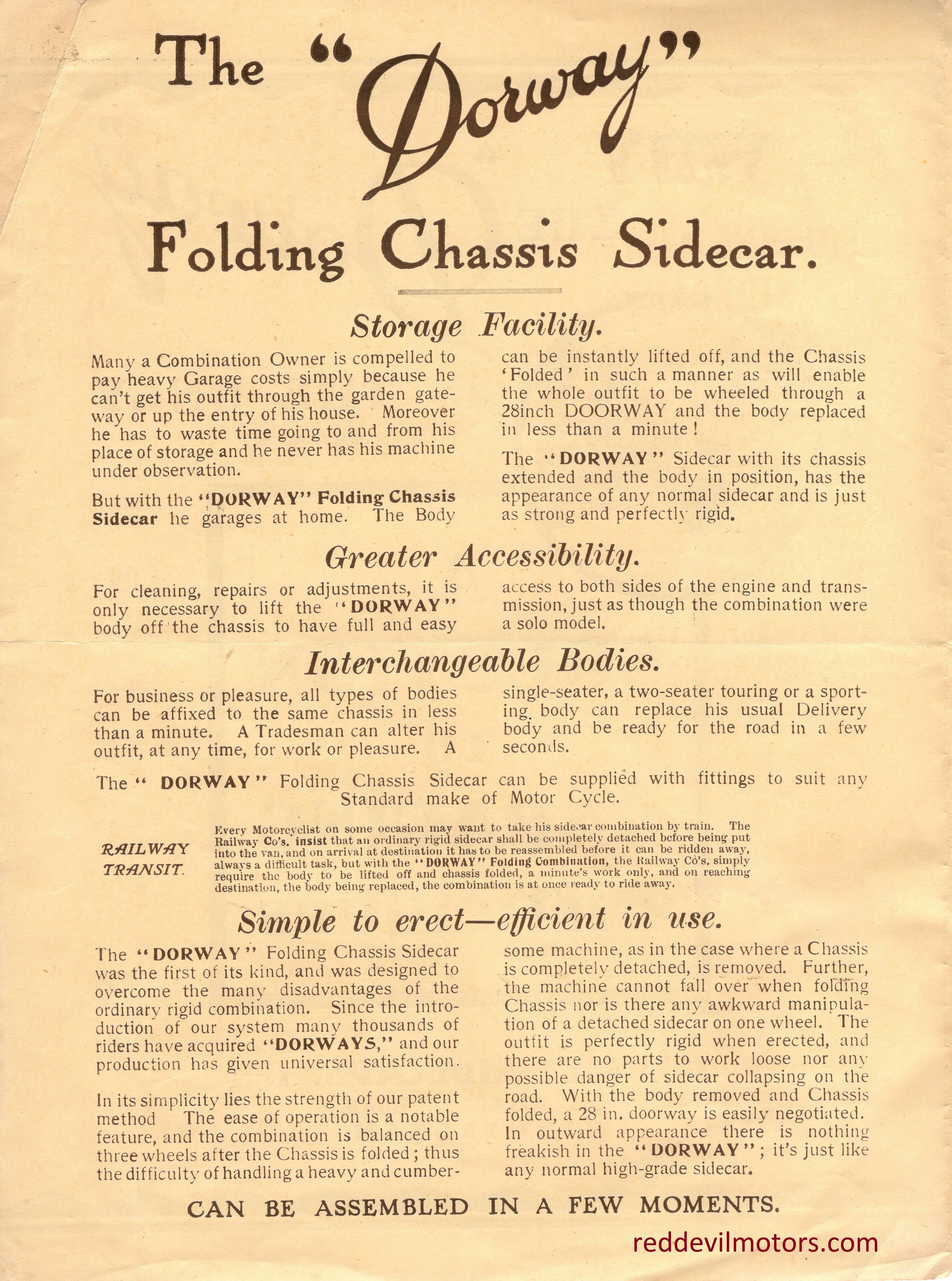
This charming brochure is for the 'Dorway' folding sidecar. Very much a product of its times. Back in the day you weren't allowed to park on the street overnight as streetlights were turned off at midnight.
It's hard to date the brochure exactly but it is more than likely from the early twenties. Several other sidecar manufacturers offered folding sidecars. The surviving British sidecar manufacturer Watsonian's first offering was folding model from 1912.



Below the flyer for the 1925 ohv JAP v-twin Packman and Poppe racing 1000cc v twin. A formidable looking machine of which (as far as I am aware) there are no survivors.
Happily several P & P machines do however survive with different engines fitted, apparently there was just the one frame design which would take anything from a small sidevalve up to this beast of a JAP twin.
P & P have an interesting, if chequered history. The bikes have several distinctive features, notably an early use of a fully duplex cradle frame and the fact that the rear wheel bearings are hung in the frame rather than the wheel itself. The company was founded by Gilmour Packman and Erling Poppe and bikes were produced from 1922 up until 1930.
Packman was unfortunately killed in 1925 in an argument with a salesman when he stopped off at the company offices on the way to the TT. Later in the year the factory was destroyed in a fire. In 1926 the company was sold to John Wooler of Wooler motorcycles fame.
Erling Poppe later went on to design the Sunbeam S7 in line twin.
 |
| Flyer for the 1925 v twin racing model P & P. |
Another edition of that venerable journal, 'Power Pak News'! It seems like Power Pak had a penchant for delivering advertising material in newspaper form - see the 'Financial Edition' from 1953. The Power Pak folks hitting you with raw facts!
The scan is slightly crinkly, but as ever if viewing from a pc, right click, open the image in a new window and click on to enlarge to full res.


Here's the range of DMW (Dawson's Motor Works) machines for 1954. Leslie 'Smokey' Dawson was a well known pre-war grass track rider. When the War started he was ineligible for service in the armed forces due to his grass track riding injuries, instead he became an RAF mechanics instructor and despatch rider. Later on in the War he opened up a small garage in Wolverhampton - Dawson's Motor Works.
Smokey Dawson is in some places credited with patenting several important developments in motorcycle development (swinging arm suspension, telescopic forks and double sided front brakes). This is indeed true but it is perhaps more fair to say that he patented minor modifications to existing technology that allowed him to produce such parts without infringing existing patents. None-the-less he was certainly an innovator and one who embraced moves forward in technology.
DMW machines for the large part used Villiers engines and were of high quality with some unusual features, some models had semi-monocoque frames and many were fitted with earles forks. For a while I owned a DMW Cortina and a fine machine it was too.
The 1954 range is interesting in that this is the year that DMW listed machines fitted with French built AMC engines (a different company from the British concern Associated Motor Cycles). The French AMC motors were fitted with ohc engines (DOHC in the case of the racing model) and looked quite glamorous and exciting. Sadly it appears that these machines only reached prototype stage, they were exhibited at motor shows but seemingly did not roll off the production line.
There's a good history of DMW at the historywebsite.co.uk


Through the fifties some of the more innovative and interesting motorcycle manufacturers were the smaller guys who built bikes using Villiers engines. DOT definitely fell into that bracket along with Cotton, Greeves, DMW and several others.
DOT were a brand with an illustrious pre-war history, though never in high volume production. Whereas pre-war DOT had used JAP and Blackburne motors along with Villiers, post-war Villiers was the only real option. The post-war range was more off-road competition focussed but there were road bikes too. The most notable post-war DOT feature was their consistent use of Earles forks.
It's timely to reproduce this brochure now as the brand DOT is currently being revived. There are two models being lauched, a street scrambler and a cafe racer both with 650cc parallel twin motors of Kawasaki design but licensed out to China manufacture. There's a DOT website for further details of the bikes, much is made of the bike's Manchester heritage but the site is written in a strange not quite native English. Whatever the story behind that is, the bikes look good and you've got to wish them success.


Three separate flyers for post-war Resilion products. The range of alloy brakes, levers and the locking lever were introduced in 1948.
The locking lever may seem like rather a feeble security device to modern eyes but these were times when just some small deterant would be sufficient. Back then cycle thieves didn't have vans, bolt croppers and battery powered angle grinders!
Resilion brakes were introduced in 1929 and ruled the roost for braking effiency for a couple of decades with very little real competition in the lightweight market. There's a great history of the Resilion brand over on the Classic Lightweights site.


Wow! Never even knew of the existence of this one until I scored this brochure. One can only guess that the lads at Sprite had seen the Fantic Chopper and thought, 'we can do that too'. As far as I can work out it's just the motocross model modded with a banana seat, ape hanger bars and an elevated headlight, wild! The motor was the buzz saw-like Sachs 125cc two stroke.
Definitely a machine of its time. I wonder how many, if any, were made and if there is a survivor out there?
 |
| Join the Swing to Sprite with the early seventies Moto-Chopper. |
A real obscurity here. The brochure for the Kyffin Sapphire range of Villiers powered off-road machines.
Roger Kyffin had a shop up in Cheshire and was a prominent scrambles rider. He made several specials based around DOT frames with Triumph or BSA engines and then from 1963 to 1966 produced the 250 Moto-Cross and the Red Rose Trials with Villiers 250 engines. All of his machines were known as Sapphires.
 |
| Kyffin Sapphire 250 Moto-Cross. |
 |
| Kyffin Sapphire Red Rose Trials. |
I'm a fan of Moto Rumi, their machines combine two loves of mine: two stroke twins and quirky engineering.
The Formichino really is a symphony of the unusual. No frame to speak of, a rear casting for the aft of the bike and a vertically split front casting to carry the front end with the engine in the middle holding the two together. The quirkiness even extends to Rumi making their own fasteners with their own pattern of heads for holding the frame members together.
All very unusual but also highly effective. Rumis were a quality product, notably smooth and notably fast. One famous marketing gambit for Rumis in the UK was to balance a 'threepenny bit' (a wide 12 sided coin) on the crankcase and rev the engine, the coin would allegedly stay stock still. The Formichino was even available in production racing trim as the 'Bol d'Or' model commemorating Rumi's victory in that event.
Rumis never sold in great numbers in the UK being very expensive (in part from import tax and in part from just being bloody expensive bikes to make compared to lesser machines) and only available in 125cc size. They were moderately successful however through the rest of Europe and were made under license by Sarolea in Belgium and there was a subsudiary company in Argentina.


Advertising material in newspaper format - that old gambit to make your message seem more authoritative...
In this case the good people of Power Pak are persuading you that their cyclemotors are unfeasibly cheap and that they don't chew up tyres as popular rumour might have it.
The brochure is undated but the Power Pak was introduced in Spring 1950 and there is a testimonial contained within stating 2 and a half years of use. The price of the Power Pak was reduced to 25 Guineas in early 1953 so it's a fair assumption that this edition of Power Pak News was published marking this price reduction.
For more information on the Power Pak check the icenicam page.
Also have a look at the nacc archive.


