This brochure / manual is a copy of a copy but is rare enough that it warrants reproducing here.
The leaflet is labelled as 1898 and I believe that Ariel Tricycles and Quadricycles were current from 1898 to 1902.


Vintage and classic motorcycle blog. Documentation of a life-long two wheel passion. Tales from the workshop, period photos, brochures, event reports, rides and anything else two-wheel related. Keeps me sane whilst working at sea.
This brochure / manual is a copy of a copy but is rare enough that it warrants reproducing here.
The leaflet is labelled as 1898 and I believe that Ariel Tricycles and Quadricycles were current from 1898 to 1902.

The Arbuthnot has been on my events 'bucket list' for a good long while. I can remember spectating it as a young whippersnapper with my father when there was a section next to 'Zig Zag Hill' just up the road from home.
The Arbuthnot has always been a proper old school trial with emphasis on traditional non-tricked out and modernised trials bikes with a good turn out of rigid framed machines. There is a 'colonial' class for road biased bikes. I seem to remember that way back when the trial was only open to rigid framed bikes. Times have moved on however and now all pre-65 British machines are welcomed.
First run after WW1 as a reliability trial the original Arbuthnot carried on through to the late twenties. The event is named after local 1900s TT hero Admiral Sir Robert Arbuthnot and was revived by the Salisbury Motorcycle and Light Car Club in the eighties and runs a route of some 70 to 80 miles along the green lanes, droves and farmland south of Salisbury.

My entry came courtesy of my friend Matt who kindly volunteered to hitch his sidecar on to his Ariel HT5 which he had entered as a solo when he found out that I was free for the day.
We had a fantastic day of riding. The event truly lived up to expectations. It's fair to say that it was tough going with the sidecar. The Dorset green lanes tend to be heavily rutted and easy going on a solo but when your third wheel is on a track that doesn't correspond to any of the ruts things can get uncomfortable.
We did manage though to clear a few of the sections and only had one spectacular 'off' where we rolled it into a clump of bracken. A soft landing at least.
There were four outfits entered. Purely by dint of being the only finishers we went home with the class winners award. Only just mind as our progress was so lethargic that we barely made the last three sections in time, the marshals had just started to take down the flags not expecting anyone else to come through so late...
A thoroughly recommended event with a great sense of camaraderie and one that I will certainly return to. Might just go for a solo entry next time though.
Following a few photos and clips from the day. No captions, it's all pretty self explanatory.


An unusual image and an unusual bike. From the surroundings and the bright sunlight this is fairly evidently not 1930s Britain, I believe the 'WBM' prefix number plate is from West Bengal.
And the bike? Obviously an Ariel, I believe an LB or MB either a 250 or 350 side-valve and most probably from 1931 or 32. Very rare bikes now, I've never seen one in the flesh. The first Ariel 'sloper' models had very radically canted forward engines before they move to a shallower angle as on this machine before up-righting the engines once more.
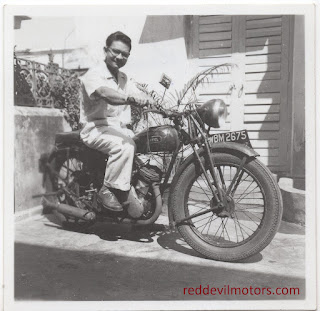 |
| Ariel side-valve in 'British India'. |

UK motorsport has resumed and one of the first long distance trials off the mark was the Torbay Trial organised by the Torbay Motor Club.
At the time of entry I didn't have a suitable bike to enter but my good friend Matt steeped in to the breech with a space in the chair of his Ariel VCH / Canterbury combo.
The day dawned with good weather forecast and off we set to the start point in Devon, just the other side of Exeter. With Covid-19 restrictions in place setting off on the trial was a cinch, just announce your name to the guy on the gate when you arrive and turn up at the start line on time, all paperwork having been filled in and checked in advance. With a 9am start, that bought another half an hour in bed on a Sunday morning, bonus. Hopefully trials organisation can continue this way after all the pandemic stuff is over.
The course of the trial was over some forty miles with 17 sections packed in. The event was very slickly organised and bikes were kept well separate from cars. When you ride an old clunker in a mixed old / new and cars / bikes trial you usually find yourself slipping further and further back as the trial goes on and getting stuck in queues of cars waiting to have a go at the sections. The sidecars were flagged off first, six of us, we the only vintage combo entered - the others soon lost us!
There were only a handful of older bikes entered, the majority coped with the sections pretty well. There were no cleans at the end of the day in the sidecar class and the top scorers just dropped a few points so I guess that means that the sections were pitched about right. Predictably on the Ariel we had the worst score of all competitors, to be honest this is expected when you enter a trial mainly for more modern stuff on an unmodified, heavy and rigid-framed early fifties machine. We only cleared one section but at the end of the day that wasn't the point. We turned up for a day's riding, had fun and broke neither riders nor machine so all in, a success and proof of the pudding is that we'll probably be back next year.
 |
| Beautifully prepared Honda XL185 looks like it received a lot of lockdown polishing! |
 |
| This little unrestored rigid James Commando trials was a gem and acquitted itself pretty well. |
 |
| Villiers 2T twin engined Cotton is an unusual choice for trialsing but a really pretty bike. |
 |
| Triumph-Metisse aiming up for a section. |
 |
| Matt on his Ariel VHA. |
 |
| Checking out the next section. They always look less steep in pictures... |
 |
| Honda XL185 starts a section. |
 |
| This contraption was eye-catching amongst the four wheeled entrants. |
Another British motorcycle industry might have been, the Ariel Pixie.
The Pixie was Val Page's last design and envisaged to be a 75cc ohc machine, a direct competitor to the Honda 90 that had scared the captains of the British motorcycle industry so much. BSA top brass are nowadays derided for watering down Page's design to a 50cc ohv engine and that is held as the reason that the Pixie was a sales failure but the real reason is far wider than that. Honda succeeded because they had new state of the art machinery capable of pushing out C90s manufactured to very fine tolerances in their thousands. Not only this but Honda had a huge market in Asia right on their doorstep. BSA on the other hand were producing bikes on outdated machinery and selling to a limited market of the former Empire and the States. It didn't matter at all what fantastical world-beating design came off the drawing board the sad reality is that when it came off the BSA production line it was always going to be more expensive and less reliable than a Honda Cub. If Honda themselves had licensed BSA to produce the Cub on the BSA production line it would have probably leaked oil and had reliability issues.....
Disregarding the above the Pixie is a cute little machine and for my eyes the styling is right. They are now something of a rarity and the production run was short - 1963 to 1965. This particular brochure is dated 1962, presumably printed in time for the Earls Court Motorcycle Show held in November.


 |


 |
| Broken down with a puncture on the 'short' Gilgil - Naivasha road. Aug 1950. |
 |
| Me and my 350cc 1943 Ariel. |
 |
| Bill and I about to leave for a ride. Gilgil Aug '50. |
 |
| Suffragettes' delight. Edwardian Ariel cycle. |
 |
| Canvas and celluloid chainguard. |
 |
| Note unusual tube profile. Unusual to fine the original skirt guard complete. |
 |
| Wonderful. The Dunlop Tyre. |
 |
| And those strangely profiled forks. Reminiscent of Humber twin tube forks but made from one piece of metal. |
 |
| Forks bottoms. Beautiful piece of craftsmanship how the tube profile blends down in to a regular oval type fork. |
 |
| Ornately tooled saddle. |
 |
| Such detail! |
 |
| Not sure of the brand of saddle but here is a maker's mark. |
 |
| And another mark t'other side. |
 |
| Really a very fine saddle! |
 |
| Ariel KH 500 twin looking at home in the tropics. |
 |
| Josephine is an Ariel NH350. |


