Showing posts with label charlie lucas. Show all posts

Monday, September 5, 2022

Charlie Lucas Motorcycles

The inspiration for this article - my Charlie Lucas
Royal Enfield.

Not many enthusiasts will recognise the name of Charlie Lucas and be aware of the motorcycles he produced through the fifties. There is virtually nothing in print about his work and equally little on the internet, his bikes may be only a side note in post war British motorcycling history but are certainly worthy of remembering.

Charlie Lucas was an aircraft engine inspector from Watford and his passion was building motorcycles, more specifically individually designed motorcycle frames. How many frames were produced over the years is unknown but he appears to have been quite prodigious for a part-time builder.

From his home workshop immediately after World War Two Charlie Lucas began making grass track frames. At some point in the early fifties his interest switched to making road racing bikes.

The best known and perhaps most successful machine that Lucas was involved with was the MELEM special which was built in 1953 and was powered by a 250cc DOHC Manx Norton engine in a featherbed style frame fitted with Earles forks, Albion gearbox, Manx Norton front brake and EMC rear. The MELEM special achieved a thirteenth position in the 1954 Lightweight TT.

The MELEM Special

Lucas also made a series of Velocette engined race bikes (apparently all fitted with 'cut down' 250cc MkVIII engines).

Although not verified it is quite possible that Charlie Lucas built frames for the series of Velocette racers produced by Doug Beasley in the early fifties. These machines were raced by Beasely himself as well as Eric Pantlin, Percy Tait and Cecil Sandford.

One of the Beasely Velocettes. Possibly a Charlie
Lucas frame. The design is certainly very similar.

A feature of many of the Lucas bikes was Earles forks and variations of this design. Charlie also experimented with low profile framed bikes.

Apologies for the terrible quality of this image.
It is a 350cc Lucas Velo from 1952. There was also
a 250cc built at the same time which was possibly
fitted with a modified Rudge engine and had the
rear suspension units mounted beneath the engine
a la Moto Guzzi of the period.

Another Lucas Velocette, this one a 250cc. This machine
embodies several of Lucas' themes - note the leading
link forks fitted with an unusual tension spring unit
behind the wheel. Also note the low profile of the machine.

Sorry, another bad quality image! This is the above
bike in build stage, the image comes from a copy
of Motor Cycling magazine from 1955.

After the series of road racing machines Charlie Lucas turned his attentions back to grass track racing and resumed production of frames for that discipline. It is not known when exactly this was but some time around 1960 is a good estimate. An article at the time gave Lucas' reason for moving back to grass track as there being less work in a grass track machine, a greater and more readily available choice of engines for the discipline yet the sport was popular enough to provide a ready market for frames. Another reason given was that competition in road racing had become ever more serious. The early and mid fifties indeed was a heyday for the small scale amateur constructor in road racing, particularly in the 250 class, one that was largely forgotten by the bigger manufacturers.

Below are images of several of the surviving Lucas machines:

Again my Charlie Lucas Royal Enfield 500 twin.

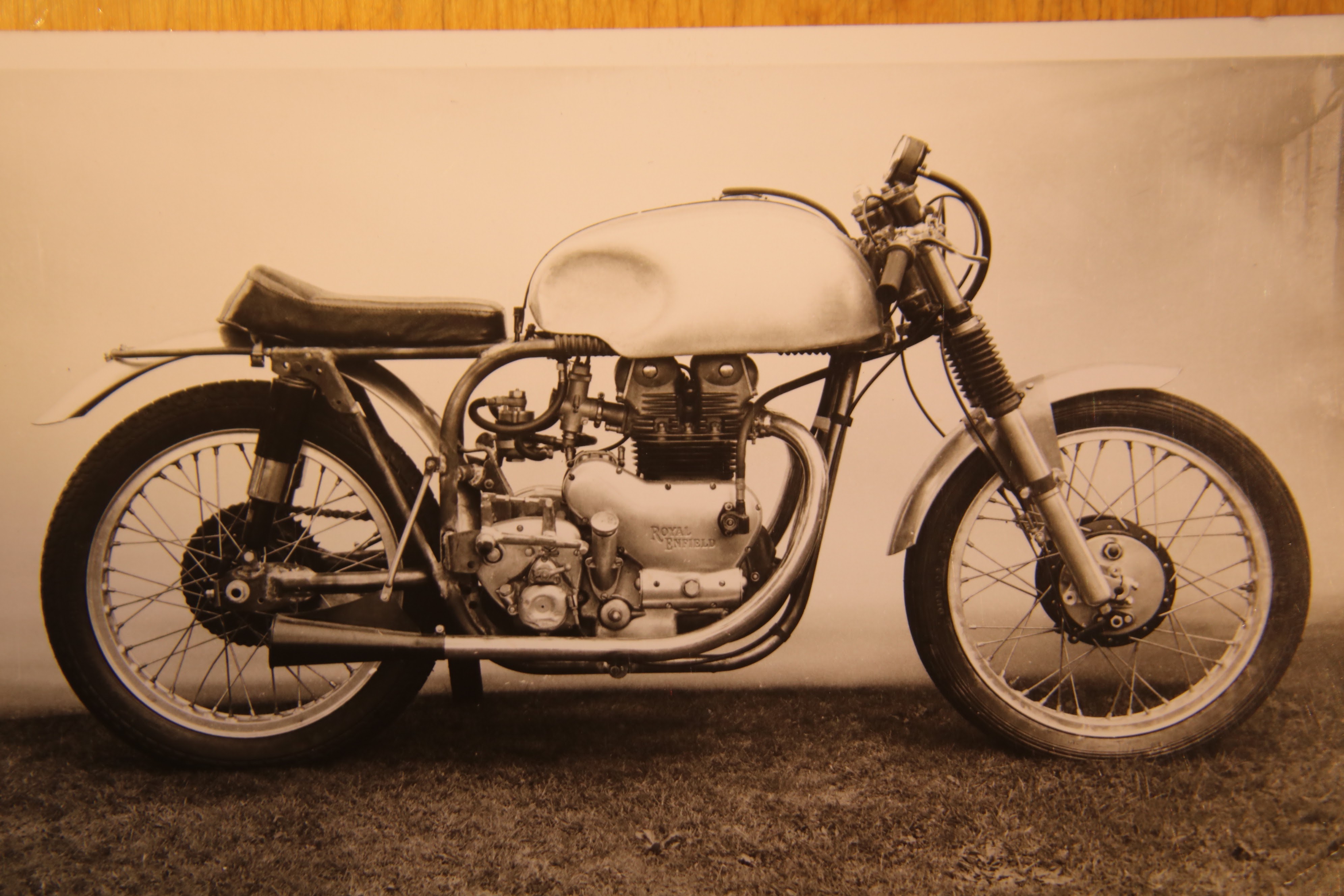
And the Charlie Lucas Royal Enfield as first built.
Sadly no more is known of its history as of yet. The
engine cases are devoid of numbers and the gearbox
is an ultra rare close ratio racing one. Both of which
suggest if not actual Royal Enfield factory involvement
then perhaps someone who had close contact with or
worked at Royal Enfield.

This sweet little Lucas framed bike is in regular use
and currently sports a Ducati Monza Junior motor
which suits it nicely. Early history is unknown but
in its time it once had a BSA Sunbeam 250cc twin
scooter engine fitted.

Easy to mistake this as just another Triton but it is
in fact Charlie Lucas frame number 24. At one
time it had an NSU 250cc engine fitted. It sports
an NSU front wheel and an EMC rear.

Images used in this article are from myself, cribbed from the internet and from personal contacts. Most have appeared elsewhere but if I have unwittingly used an image without permission or consent please let me know and I will take down or acknowledge.

Wednesday, October 13, 2021

Charlie Lucas Royal Enfield hits the road

I've owned this machine for more years than I care to admit now. It was an unloved and unknown bike in a local auction and I won it as the sole bidder with a chancer bid. Purchase came with a first flush of enthusiasm, I started it up and took it to an event or two. Then I decided that if it was to be used in anger the motor should be checked out - the motor had been run on castor oil. As I was short on time and heavy on projects it went up to Paul Henshaw of Performance Classics in Wales. I collected it running, Paul had done a cracking job as expected in stripping, cleaning and servicing. Then a misfire crept in and it was evident that the mag needed rebuilding as well as the engine. In the meantime I managed to get the bike road registered.

The mag was duly rebuilt but I got the timing wrong. Trying to test run a bike with no kickstart when you live on top of a hill is not much fun so I got dispirited and wheeled it to the back of the garage for a period of contemplation.

1950s Charlie Lucas Royal Enfield 500 Twin.

From purchase onwards I had no idea who made the bike, I had a couple of leads but they got me nowhere. Then out of the blue I saw an original picture of the bike from back in the day in the letters section of Old Bike Mart magazine. A breakthrough moment for the bike and for my enthusiasm.

It was always evident that the bike was of decent build quality and a step up from something homemade and so it proved to be. The engine is a Royal Enfield 500 twin, not a particularly noteworthy sports engine but back in the early postwar club racing scene you made do with what you had. The frame is very similar to a Featherbed Norton but with a few subtle differences. The gearbox is a rare close ratio and the only real concession to tuning seems to be the twin carbs and megaphone pipes.

The ID of the bike is that it is a Charlie Lucas made machine. Charlie was a bike dealer in Watford who had a sideline in producing speedway frames and bespoke frames for road racing. It's unclear of how prodigious his output was but it is fair to say low. Charlie was famous for making the frame of the 'Melem Special' a successful one-off DOHC 250cc machine campaigned in the early and mid fifties.

1950s Charlie Lucas Royal Enfield 500 Twin.

The next breakthrough came in the purchase over the summer this year of a set of electric starter rollers from ebay. A total gamechanger in fettling something like this. I re-timed the bike and got it running sweet. Next step road tests. It's quite a buzz riding an original and unrestored fifties road racer out on public roads. Riding position is brutally uncomfortable for my six foot two frame, the footrests are ludicrously high and all my weight falls on to my wrists. The gearing is very high and to get a decent pace up the bike needs to be thrashed, brakes are standard Enfield and though fine for a Bullet or suchlike are slightly below par for this application. I took the bike along to a local VMCC run for fun but had to decline and head back home from the start such was the discomfort...

Next steps are light fettling and further investigating the bike's history with the leads I have. It's remarkable to have a period race bike in such unmolested and original condition, this perhaps means that it wasn't used much and will be hard to trace in race results / programmes? Some time in the bike's life 18 inch rims have been fitted, I have the original 19 inch ones and shall fit these back on soon. That should improve the grace of the bike and make it look slightly less chunky. Moving the footrests will be tricky but changing the handlebars is not, so a pair of swan-neck clip-ons will be substituted. Lowering the gearing with a smaller gearbox sprocket should make it slightly more manageable (I barely managed top gear on test runs). That should all be easily achievable by next season. After that it's just to get out and enjoy using it.